Why Choosing an LED Screen Is Not Just Choosing a Product
An LED screen project can look simple at first: pick the area, pick the screen size, install the system. In reality, the difference between a screen that looks good and a screen that merely works usually comes down to technical detail. Picture two installations of exactly the same size: one looks sharp, balanced and powerful even from a distance, while the other looks too bright, pixelated, or as if it were bolted on to the space afterwards. The cause is rarely the size of the screen — it is poor planning of pixel pitch, viewing distance, brightness, content structure and physical installation. A good result starts by evaluating the space, the behaviour of the viewer and the content together.
1. A Lower Pixel Pitch Is Not Always Better
Pixel pitch is the distance between the centres of two pixels on an LED screen, usually given in millimetres: P1.5, P2.5 and P4 all describe that distance. As a rule, the smaller the pitch, the more detailed the image. The common mistake is assuming the lowest value is the best answer for every project. The right pitch is set by viewing distance. In a store or a corporate lobby where people stand a couple of metres away, a lower pitch makes sense; on a large façade screen watched from tens of metres, that pixel density may be invisible. An unnecessarily fine pitch improves the image on paper while significantly raising the cost. So the right question is not “which pixel pitch is best?” but “which pixel pitch is right for this project?”.
2. Brighter Is Not Automatically Better
High brightness is a major advantage outdoors, where content has to stay visible in direct sun. Indoors the situation is different. A screen running brighter than it needs to inside a store is uncomfortable to look at and can throw off the lighting balance of the space, turning into a light source that dominates the room. Brightness should be chosen against the ambient light level, the position of the screen, the viewing distance and how daylight changes through the day — not just the panel’s maximum capability. Professional systems can adapt brightness to ambient conditions, which is a real advantage. The best screen is not the brightest one; it is the one that adapts correctly to its environment.
3. Size Alone Does Not Create Impact
One of the first questions in any project is “how big a screen can we fit here?”. A physically large screen does not automatically create a stronger result; its proportion to the architecture matters far more. An oversized screen in a narrow store overwhelms the other design elements, while a screen that looks small in a wide atrium will not deliver the visual impact expected. Alongside the wall dimensions, ceiling height, sightlines, how people move through the space, the average viewing distance and the surrounding architectural elements all need to be considered. In a well-designed project the screen does not look added on — it reads as a natural part of the space.
4. Viewing Distance Can Matter More Than Image Quality
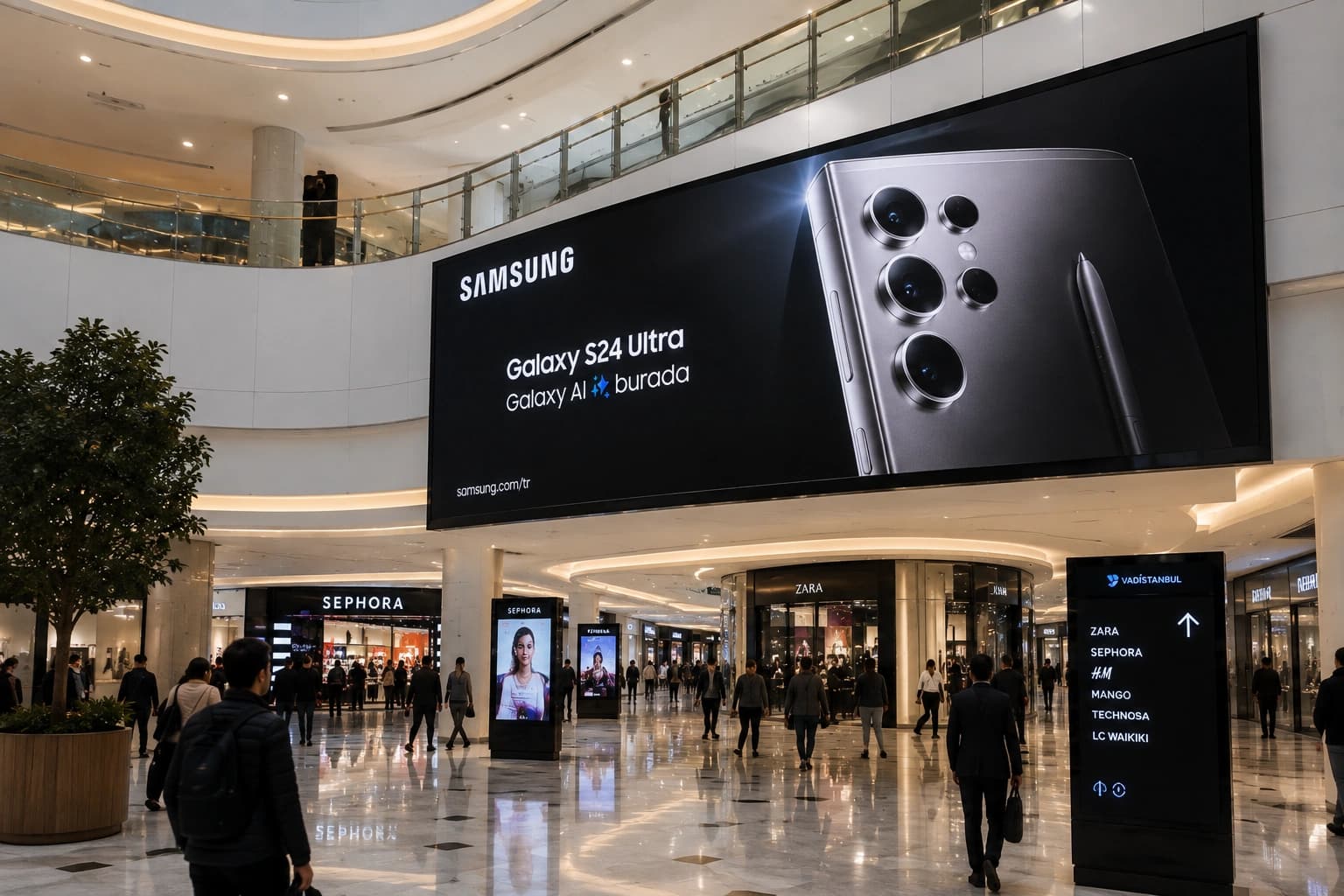
A screen may have very high resolution, but if the viewer sees it from the wrong distance most of those specifications lose their meaning. Up close the pixel structure becomes visible; from further away the eye blends it into a single image. That is why you have to work out in advance where people will see the screen from. A screen at a store entrance is seen from a few metres, a screen in a mall atrium from several floors and angles, a façade screen from tens or even hundreds of metres. These scenarios should not use technically identical screens. Correct engineering starts by analysing the viewer, not the screen.
5. Poor Content Makes Even the Best LED Screen Look Bad
Content is the most overlooked part of the process. The installation finishes, the system goes live, and existing advertising artwork is pushed to the screen as it is. If the content was not prepared for the real size and resolution of the screen, the result will disappoint. On large-format screens especially, tiny type, low-resolution images, overly detailed designs, wrong aspect ratios and low-contrast artwork all weaken the visual impact. Content should be produced for the screen’s actual resolution and viewing distance: simple compositions, strong contrast and a single clear message work best on large screens seen from far away. The viewer never sees an LED module — they see the content — so hardware and content cannot be planned separately.
6. Installation Quality Is Part of the Image
The modularity of LED technology is a great advantage, but it also raises the precision required during installation. If cabinets or modules are not aligned perfectly, the seams become visible; across a large surface even millimetric errors affect the integrity of the image. In professional installation it is not enough for the screen to switch on: the flatness of the mounting surface, module alignment, cabling, service access and the supporting structure together determine the quality of the project. A recessed screen, an application wrapping a column or a screen that turns a corner each demand different engineering. Application experience matters as much as the product itself.
7. The Cheapest Screen Is Rarely the Most Economical
LED screen systems are professional displays that often run for long hours, in some applications all day. Looking only at the purchase price can therefore be misleading. Over the life of the system, energy consumption, maintenance needs, spare-part availability, module replacement, power-supply quality and service support all shape the total cost of ownership. A system that is cheap to buy but needs frequent service can cost more in the long run — and in commercial spaces every hour a screen is dark is also lost communication and lost advertising. Evaluate the full service life of the system, not just the price of the product.
So How Do You Choose the Right LED Screen?
There is no single “best LED screen”; the right answer changes with the project. At a minimum, these questions should be answered before specifying a system: will the screen be used indoors or outdoors? What is the average viewing distance? What are the physical dimensions? How much ambient light is there? What type of content will play? How many hours a day will it run? From which angles will it be seen? How will it be integrated into the architecture? How will maintenance and service access be handled? With clear answers, product selection becomes far more reliable.
“There is no single “best LED screen”. When pixel pitch, brightness, viewing distance, content and installation quality are planned together, the screen becomes a powerful communication surface for the space it sits in.”
An LED Project Starts With Planning, Not With a Product
The flexibility of LED technology means a screen can be built for almost any size and architectural form today. But the success of a project is not decided by the panel alone: when the right pixel pitch, suitable brightness, correct viewing distance, quality content and professional installation come together, the screen becomes a powerful communication surface for its space. The first step in an LED investment is therefore not picking a model, but analysing the space and the usage scenario. At iDisplay we handle LED screen projects end to end — from needs analysis and product selection to technical design and installation — developing solutions that suit the space, the purpose and the real viewing conditions, so that the technology meets the architecture properly.
What is an LED screen?
An LED screen is a modular digital display system in which a large number of light-emitting diodes are combined to form the image. It can be built in many sizes and forms, indoors and outdoors.
What pixel pitch should I choose?
The right pixel pitch depends on where the screen is used and how far away it is viewed from. Screens watched from close range generally use lower values, while large screens viewed from a distance can use higher ones.
What is the difference between indoor and outdoor LED screens?
Indoor LED screens are designed for interior conditions. Outdoor LED screens offer high brightness, weather resistance and the protection needed for exterior use.
How long does an LED screen last?
Service life depends on product quality, operating hours, environmental conditions and the maintenance regime. Professional LED systems are built for long-term commercial use.
What should I look at when buying an LED screen?
Pixel pitch, brightness, viewing distance, screen size, the environment, content type, service support and installation quality should all be evaluated together.